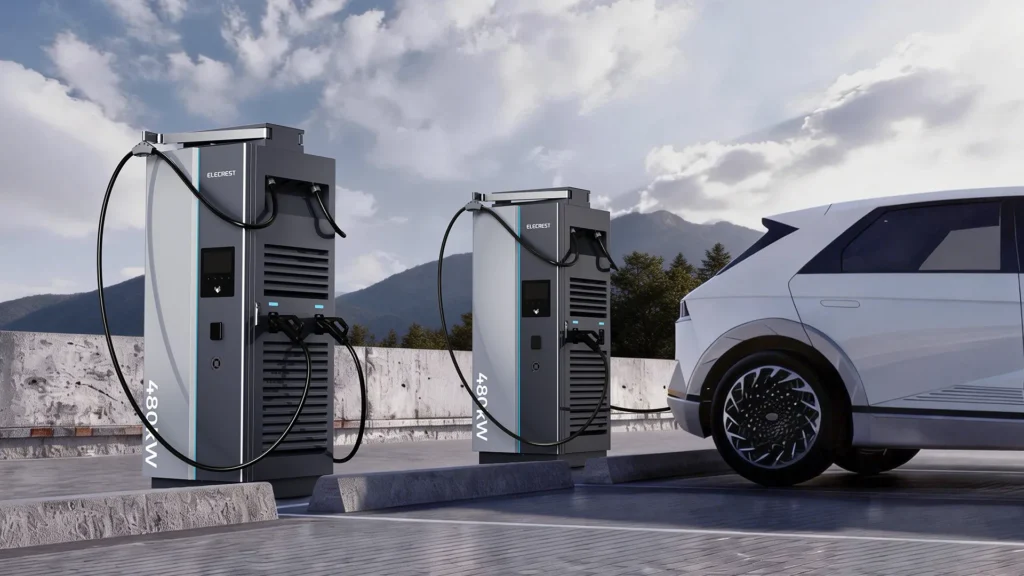
In June, the clean-tech industry convened in Munich under summer skies at Power2Drive Europe. By October, the focus shifts westward to the historic canals of ‘s-Hertogenbosch in autumn light. Heading west once again, Elecrest B.V. brings its European-standard storage and charging ecosystem to the 21st National Energy Week (National Energy Week 2026 / Vakbeurs Energie) at the Brabanthallen from October 6–8, 2026 (Booth Hall 6, Stand D059).
As the Netherlands’ largest and most comprehensive B2B energy transition summit, National Energy Week co-locates four major exhibitions: the Energy Expo (Vakbeurs Energie), the Zero Emission E-Mobility Exhibition (Zero Emission | Ecomobiel), Industrial Heat & Power, and Prefab Building. Spanning renewable generation, energy storage, charging infrastructure, industrial electrification, and sustainable logistics, this gathering highlights the continent’s most urgent dilemma: overcoming EV charging grid bottlenecks.
Deconstructing EV Charging Grid Bottlenecks: The Dutch Infrastructure Paradox
The Netherlands stands as Europe’s premier benchmark for electric vehicle infrastructure, boasting more than 140,000 public charge points and adding approximately 1,600 new units every month. Yet behind this rapid pace lies a profound structural contradiction: while charging stations can be procured and commissioned within months, upgrading aging medium-voltage electrical grids and substation transformers frequently takes two to five years.
This acute grid capacity exhaustion, known locally as netcongestie, has become the decisive barrier throttling large-scale zero-emission vehicle adoption across Europe. Along vital freight arteries connecting the Port of Rotterdam to the Schiphol logistics corridor, charge point operators (CPOs) and commercial fleet depot managers are denied additional peak load connections. Addressing this systemic bottleneck requires moving beyond conventional substation expansion toward intelligent multi-port load sharing and flexible battery-buffered charging architectures.
Squeezing Maximum Throughput from Existing Connections: Architectural Solutions
Overcoming local grid bottlenecks begins with optimizing conversion efficiency and dynamic load distribution. Elecrest’s flagship HIMA 480 DC fast charging platform addresses grid capacity limits through two core architectural capabilities:
1. Dynamic Power Allocation: Eliminating Capacity Waste
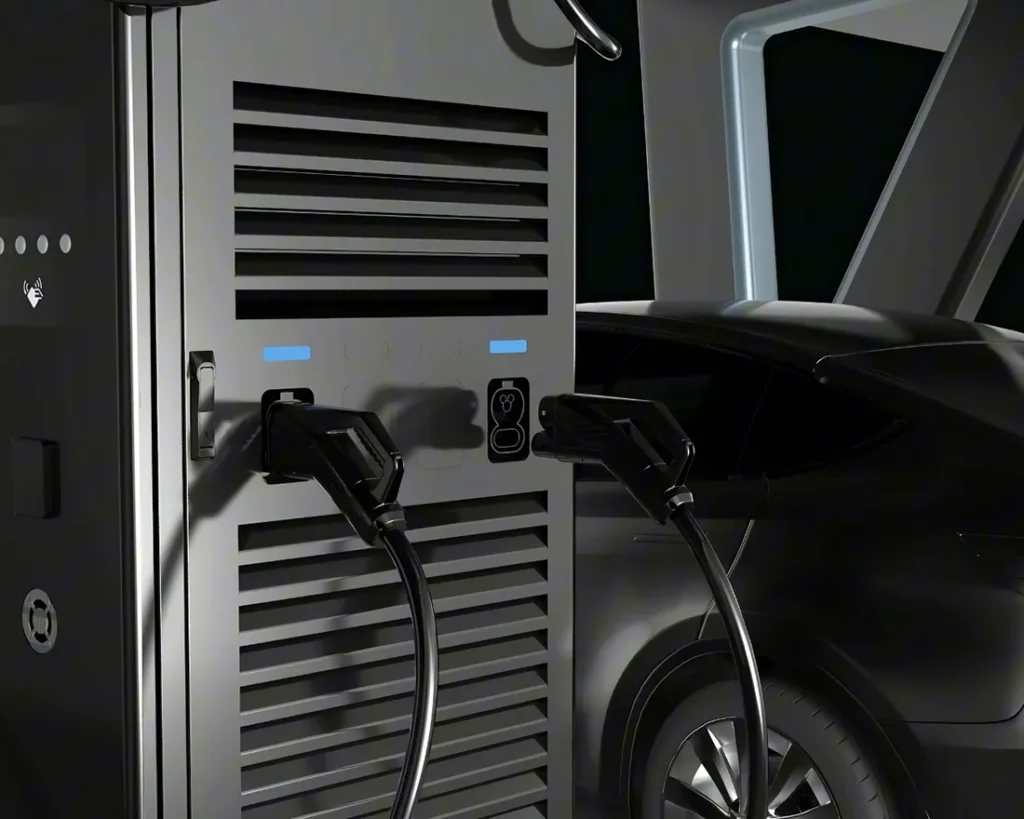
Conventional dual-port chargers rely on fixed 50/50 power splitting, locking valuable transformer capacity to an idle cable or a vehicle nearing the end of its charging curve. Elecrest’s dynamic power allocation continuously balances output across dual high-current CCS2 ports in granular increments based on real-time vehicle battery state of charge (SoC) and battery management system (BMS) acceptance limits. Rather than reserving fixed transformer capacity per stall, a single 480 kW unit balances power across multiple commercial vehicles, maximizing total station throughput without tripping local transformer thresholds.
2. 97.5% Conversion Efficiency: Minimizing Energy Losses
In capacity-constrained environments, internal electrical dissipation directly worsens grid strain. The HIMA platform achieves a peak conversion efficiency of up to 97.5% across a wide DC operating range of 150V to 1000V DC. Supporting both 400V delivery vans and next-generation 800V heavy-duty commercial trucks, this high efficiency lowers thermal dissipation, minimizes auxiliary cooling energy, and delivers maximum usable power to vehicle batteries.
Field Resilience in Coastal Environments: Defending Uptime and TCO
In addition to grid constraints, commercial infrastructure throughout Western Europe must withstand rigorous environmental conditions. In coastal logistics corridors across the Netherlands, Belgium, and Northern Germany, high atmospheric humidity and dense salt mist pose persistent risks of contact corrosion and dielectric breakdown.
Isolated Airflow Cooling: Eliminating Contaminant Ingress
Standard forced-air chargers draw outdoor air directly across internal circuit boards, exposing microprocessors and communication buses to corrosive moisture and airborne particulates. The HIMA series implements isolated airflow cooling, structurally segregating the power converter heat dissipation duct from the sealed electronic control chamber. Achieving IP65 module-level and IP55 cabinet-level ingress protection, this design forms an impermeable physical shield against salt mist, condensation, and industrial dust.
Three modules structure: Slashing Mean Time to Repair (MTTR)
With European technician call-out charges frequently exceeding hundreds of euros per hour, downtime quickly damages station profitability. The HIMA architecture decouples the charger into a 3-Box plug-in modular structure: power conversion, system control, and communication interfaces operate in independent sub-enclosures. When automated diagnostics identify a fault, field personnel can slide out and replace the sealed module in minutes without complex on-site wiring disassembly, slashing Mean Time to Repair (MTTR) and protecting station uptime.
Fast Charging on Wheels: Mobile Energy Storage Bypasses the Grid
For fleet depots, logistics parks, and temporary construction hubs where permanent grid reinforcement is delayed for years, stationary hardware alone cannot solve immediate operational needs. To bridge this gap, Elecrest developed the HIMA 156kWh Mobile Energy Storage & Charging (MESC) Vehicle.
Integrating automotive-grade lithium iron phosphate (LFP) battery storage, bidirectional power conversion, and DC fast-charging outputs on an agile mobile platform, the MESC vehicle requires zero civil excavation, zero grid permitting, and zero permanent trenching. Operators can recharge the vehicle during off-peak hours or from on-site solar generation, dispatching high-power DC fast charging directly to commercial vehicles during fleet turnaround windows. Scalable capacity configurations (including 70kWh and 105kWh variants) allow operators to match battery storage precisely to site duty profiles.
Beyond the Trade Show: Sustained European Presence Builds Commercial Trust
Following the conclusion of Power2Drive Europe in Munich, Elecrest took its engineering from the exhibition booth directly into customer project sites across Europe. Over recent months, our European engineering teams conducted comprehensive on-site consultations with local CPOs, distribution channels, electrical installation contractors, and fleet operators.
These engagements focused on validating real-world operational requirements: local grid interconnection parameters, regulatory certifications (CE, AFIR, ISO 15118 Plug & Charge, OCPP 1.6 J and 2.0.1 J), contactless payment terminal habits, and preventive after-sales maintenance. In European capital infrastructure, trust is not built on a single appearance—it is earned through continuous, on-the-ground presence and dedicated local accountability.
Headquartered in Rijswijk, the Netherlands, Elecrest backs its hardware with European spare parts distribution, local engineering support, and direct field service. Visit the Elecrest team at the 21st National Energy Week (Brabanthallen, ‘s-Hertogenbosch, Booth Hall 6, Stand D059) from October 6–8, 2026, to discuss how modular DC fast charging and mobile storage can unblock your charging capacity roadmap.